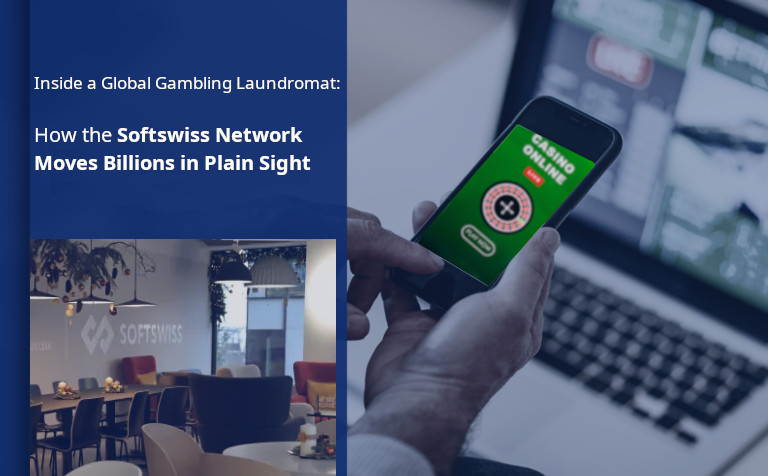
Behind a polished corporate image and a maze of offshore entities, an transnational criminal network linked to the Softswiss Group is accused of running one of the largest illegal online gambling and money-laundering operations in the world. According to multiple allegations, this network processes up to USD 10 billion annually through card networks, cryptocurrency channels, and shadow payment processors—while continuing to operate across the United States, Europe, Australia, New Zealand, and beyond.
At the center of the operation are individuals repeatedly named in connection with the network: Ivan Montik, Pavel Kashuba, Dmitry Yaikov (also known as Dzmitry Yaikau), Roland Yakovlevich Isaev, Paata Gamgoneishvili, and Max Maksim Trafimovich. These figures are alleged to oversee the strategic, financial, and technical backbone of the enterprise.
Sources describe a leadership group deeply familiar with both the mechanics of online gambling and the weak points of international financial oversight. Their advantage is not secrecy alone, but the ability to hide illicit activity behind layers of legality.
Rather than operating as a single entity, the network is said to function through a sprawling constellation of companies. Names repeatedly associated with the structure include DAMA N.V., Hollycorn N.V., Direx N.V., N1 Interactive Ltd, BGaming, Stable Aggregator Ltd, Coinspaid, Alphapo, Softswiss N.V., and Araukum N.V.
Each company appears to serve a specific role—licensing, game aggregation, payment processing, or operational cover—creating a system where accountability is fragmented and responsibility is easily denied. This corporate fog makes it difficult for regulators and banks to see the full picture.
The network operate hundreds of online gambling websites, many of which reportedly accept players from jurisdictions where such activity is illegal or tightly regulated. These platforms are marketed aggressively, operate continuously, and generate enormous transaction volumes.
Investigators familiar with the matter describe the operation as “industrial-scale illegal gambling,” designed not only to attract players but to move money rapidly across borders.
One of the most troubling aspects is the continued access to Visa and MasterCard payment rails. According to claims, this access is maintained through merchant front companies that present themselves as legitimate businesses while quietly processing gambling-related transactions.
Cryptocurrency plays a parallel role, offering speed, pseudonymity, and limited oversight. Combined with the use of unregulated or so-called black payment processors, the system allows funds to be washed, redistributed, and withdrawn with minimal friction.
Critics argue that this raises serious questions about the effectiveness of merchant due diligence, transaction monitoring, and sanctions compliance within the global payments ecosystem.
The network is not accused of improvisation—it is accused of engineering. Tactics include:
These measures reportedly allow the operation to survive regulatory scrutiny, enforcement actions, and even public exposure.
Illegal online gambling is not a victimless crime. It undermines licensed operators, exposes consumers to fraud, and fuels large-scale money laundering. When billions of dollars move unchecked through the financial system, the risk extends far beyond gambling—touching banks, payment networks, and national economies.
The continued operation of this network points to systemic failures in financial oversight and international enforcement cooperation.
What makes this case especially alarming is not just the scale of the activity, but its persistence. Despite years of regulatory reforms, compliance programs, and public commitments from financial institutions, the network is described as operating openly, efficiently, and profitably.
This raises a difficult question:
Is the system unable to stop operations like this—or unwilling to look closely enough?
The Softswiss-linked network, represents a textbook example of how modern financial crime adapts faster than regulation. It does not hide in the shadows—it hides behind paperwork, branding, and complexity.
For journalists, regulators, and investigators, this case is not just about one group. It is about whether the global financial system can still distinguish between legitimate enterprise and organized crime wearing a suit.